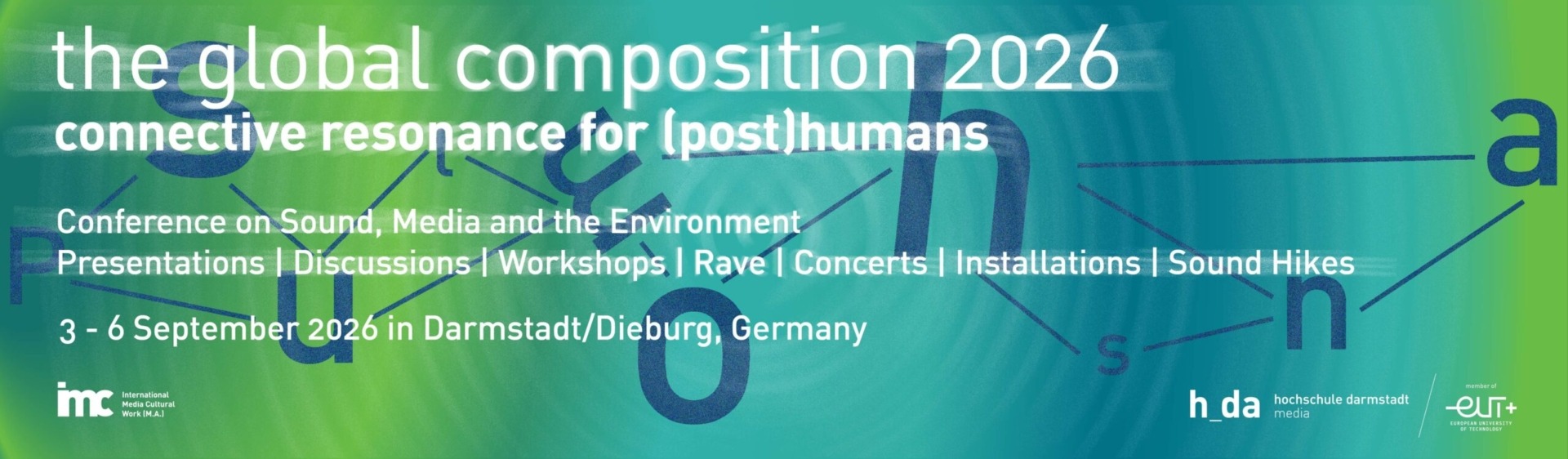
3 – 6 September 2026 in Darmstadt/Dieburg
The Global Composition 2026
the global composition 2026
connective resonance for (post)humans
Conference on Sound, Media and the Environment
3 – 6 September 2026 in Darmstadt/Dieburg
Hosted/supported by International Media Cultural Work (IMC) & Research Center dkmi at Darmstadt UAS, European University of Technology in collaboration with Frankfurt University of Applied Sciences, Hochschule Fulda, Hessian Film and Media Academy hFMA, Centralstation Darmstadt, Internationales Waldkunst Zentrum (IWZ), World Design Capital 2026 Frankfurt Rhein-Main.
This interdisciplinary conference explores the relationships between acoustic ecology/soundscape studies and democratic processes, social cohesion, sustainability, and participation. Drawing on Peter Sloterdijk’s concept of the “social bond of audiophony,” it examines the extent to which soundscape research – together with analyses of its health-related, social, and aesthetic dimensions, as well as the creative practices and auditory poetologies that emerge from it – can contribute to strengthening democratic structures, sustainable processes, and participatory cultures.
At the heart of acoustic ecology and soundscape studies lies the investigation of the relationships between living beings and their environments through the auditory. The conference places a particular emphasis on listening and sound practices that foster social cohesion by intentionally incorporating voices that are often marginalized as “individual,” “foreign,” or “other”. Special attention is given to educational and facilitating practices that enable individuals and groups to engage with sound environments in deeper sensory and cognitive ways. The aim is to sharpen auditory-aesthetic awareness and, in turn, to deepen social relationships with both the living environment and the environment at large. This approach is closely linked to an ethic of care that encourages resource-conscious, sustainable, and ecologically responsible ways of thinking, acting, and designing (Yuriko Saito).
Furthermore, the conference critically examines anthropocentric paradigms underlying the field. It seeks creative and scholarly approaches to developing acoustic ecology and soundscape studies from a posthumanist perspective. Building on Donna Haraway’s concept of relational structures between human and non-human actors, auditory interactions are understood as distributed constellations involving humans, technical systems, and other entities. Against the backdrop of learning, adaptive, and agentic systems, the conference will explore how relational and context-dependent listening practices – particularly those mediated by technology – can redefine the notion of an acoustically beneficial environment that is both sensorially and intellectually stimulating.
This perspective aligns with the foundational aim of soundscape studies and their transformative research approach: to shape acoustic environments and their contextual conditions in ways that support health, mental well-being, social interaction, and aesthetic experience.
The conference includes scientific and artistic lectures, papers, posters and presentations, workshops, concerts, performances, installations, discussion panels, and joint listening sessions, the latter preferably while engaging in physical movement (walking, hiking, dancing…).
5 February 2026: Call for Proposals starts on EasyChair
1 April 2026: submission closes
15 May 2026: notification of acceptance
1 July 2026: camera ready deadline
3 September 2026: conference start
The conference attaches great significance to face-to-face encounters on site. However, the organizers are endeavoring to provide some online slots for paper and poster presentations and, where applicable, for fixed media compositions and audio productions.
Our conference will take place at the Media Campus Dieburg and other venues in Darmstadt. Dieburg and Darmstadt are located in the Rhine-Main area and are easily accessible by train, bus, car and plane (Frankfurt Airport).
A stay at the Media Campus Dieburg can be easily combined with a visit or even a vacation in the lovely surrounding area: The Odenwald offers excellent hiking opportunities, picturesque medieval towns, good wine and food, and pleasant, affordable accommodation.
Welcome!
Your Darmstadt conference team
Hazem Obid, Klaus Schüller, Robin Wiemann, Prof. Dr. Judith Bihr and Prof. Sabine Breitsameter (both conference chairs)
Master’s program International Media Cultural Work (IMC).